

Congratulations to the Winners of the Astoria Column Writing Contest!
Join us on July 18th throughout the day to hear the winners read their work.
Memoir Winners: (Joanna Rose Judge)
“The Living Monument” by Glenn T Harding
“Flight of the White Bird” by Sandy Brown Jensen
Third Honorable Mention: “Beacon of History” by Dede Montgomery
Poetry Winners: (Ellen Waterston Judge)
First Place: “The Spiral of Us” by Katherine Rehnert
Second Place: “Before the Column” by James Dott
Honorable Mention: “Love for Astoria” by Alyssa Diggdon
Youth Winners: (Marianne Monson Judge)
“Standing for a Century” by Jordan Josephson, nonfiction
“Acrostic Column” by: Izzie O’Connor, poetry
Memoir Winners
-
I arrived early, before the fog had decided whether to lift.
The road curved upward through damp trees, each turn narrowing the world until it felt as though I was being guided somewhere quieter than a destination — somewhere that required a kind of attention I wasn’t yet sure I had.
When I reached the top, the Astoria Column was there, but only partially — its upper half dissolving into gray. It didn’t announce itself. It emerged.
That felt right. For a place meant to hold history, it did not feel fixed. It felt patient.
In 1926, the Column was built to tell a story. Its spiral frieze traces the region’s past — from the discovery of the Columbia River, through Lewis and Clark exploration, fur trade, migration, and the arrival of the railroad. It was, in many ways, a visual timeline — a monument to progress, to endurance, to the idea that history could be gathered, ordered, and preserved.
Standing there, though, I didn’t feel like I was looking at history. I felt like I was standing inside it. The wind was constant. Not harsh, not dramatic — just present. It moved through the trees, across the open space, and along the surface of the Column itself, as if tracing the spiral with invisible hands.
I walked slowly around the base, following the carvings.
Up close, they were less definitive than I expected. The figures blurred at the edges. The lines softened. What seemed clear from a distance became more interpretive, more uncertain.
It struck me then: this wasn’t a record. It was a version. I thought about what wasn’t there.
Long before 1926 — long before the arrival of ships or rails —this place was already full of meaning, shaped by generations of Indigenous peoples, including the Chinookan peoples. Their histories are not fully told on the Column’s surface, yet they are present in the land itself — in the river’s path, in the trees, in the feeling that the place holds more than it shows.
That realization didn’t diminish the Column for me. It changed it. I decided to climb.
Inside, the staircase coils tightly, the light narrowing as you move upward. The spiral that appears expansive from the outside becomes something more intimate, more physical. Each step feels like part of the story, but not in a way that resolves.
There is no moment where it all comes together. Only ascent.
When I reached the top, the fog had begun to lift.
Below me, Astoria spread out in quiet detail — rooftops, docks, streets still holding the early hour. Beyond it, the river widened, stretching toward the Pacific, its surface shifting in ways that made it impossible to tell where one body ended and the other began.
It was not a clean boundary. It was a meeting. That, more than anything, felt like the truth of the place. Not a single story, but a convergence. Not a finished past, but an ongoing one.
From above, the idea of a “complete” history felt almost impossible. Too much had happened. Too much continued to happen. The Column, for all its intention, could not contain it. And yet, it didn’t need to.
When I came back down, I didn’t look at the spiral the same way. I saw it less as a definitive account and more as an invitation— a starting point rather than a conclusion. It offered a way in, not a final word.
Visitors moved quietly around the base. Some paused, reading. Others simply looked outward, toward the river and the sea.
Each of us, I realized, was bringing something with us — memories, histories, questions — and placing them, invisibly, into the space the Column holds.
Not carved. Not permanent. But real.
At one hundred years, the Astoria Column no longer stands only as a monument to what has been. It has become something more dynamic:
A place where history is not just remembered, but reconsidered.
A place where the past and present meet like river and ocean, in constant motion.
A place that acknowledges, even if quietly, that no story is ever complete.
As I left, the fog had fully lifted. The Column stood clear against the sky now, its spiral visible from base to top. It looked solid, certain, as though it had always known exactly what it was.
But I knew differently.
Or maybe I had simply learned to see differently.
Because what stayed with me wasn’t only the structure itself, but the feeling of standing there — of being part of something still unfolding.
A living monument. Not because it changes in form, but because we do.
-
I left Eugene on a bright February 22, 2023 day. A skiffling of snow on the Coburg hills seemed more scenic than menacing. I’d dubbed my brand new Subaru Forester “White Bird.” I saw her as just a child, really, and we sailed north on our shakedown trip. I held the Astoria Column in my mind like a distant beacon calling us in for a weekend of carbon printing at the Lightbox Photographic Gallery.
The conventional route is to drive straight north through Portland to the Washington side for forty miles, then turn west at Longview and cross back to the Oregon side on the Lewis and Clark Bridge for the fifty mile run out to coastal Astoria.
Around Albany on I-5, a text came in from my sister warning me that Portland was snarled up in snow. I didn’t know it at the time, but that afternoon, a historic, unforecasted winter storm caught the entire metropolitan area completely off guard. While the maps had predicted only a minor brush of winter, a massive squall stalled over the city like a heavy winter shroud, dumping nearly a foot of snow in a matter of hours. It was a freak Arctic ambush—Portland's second-snowiest day in recorded history.
Because the storm hit right at the beginning of the evening commute, it triggered absolute gridlock. Emergency sirens and digital alerts flashed across the region, warning drivers to shelter in place as the city's great concrete arteries—Interstate 84, Interstate 5, and Highway 26—ground to a complete standstill. Jackknifed semi-trucks lay like fallen giants across the icy lanes, trapping thousands of commuters in a frozen, hours-long purgatory.
Desperate drivers eventually gave up. More than 600 vehicles were completely abandoned on the freeways and city hills, turning the city's major corridors into a post-apocalyptic scene of snow-covered cars.
But that was all to come. I got the message and simply turned right toward the coast at Salem. I’d cross over on the Salmon River Highway and turn north on 101 and cruise on into Astoria in time for dinner before my workshop began in the evening. No snow worth talking about in Salem, still a beautiful day.
Sourgrass Summit sits only at 676 feet above sea level. It serves as a low-elevation gap where the damp breath of the coast collides with the cold air of the Willamette Valley. It is a treacherous stretch, notorious for breeding sudden, blinding walls of fog and microscopic sheets of black ice that wait like traps for the unsuspecting. However, it never snows on the coast in my experience, but if it did, I reasoned erroneously, it would be wet, warm and slushy, no real challenge for my new baby, White Bird.
Travelers have been surprised by this coast long before my hair raising trip, and these journeys have been commemorated on the Astoria Column. The Column itself is a 125-foot monument on Coxcomb Hill. Its mural, over 525 feet long if "unrolled," depicts fourteen significant events, including the discovery of the Columbia River, and just about all of them place Astoria at the end of a difficult journey. I was to be no exception.
The mural chronicles the long, difficult overland and maritime routes taken by pioneers who risked everything to establish a new life in the Oregon Territory. I wondered who I was to complain about a little snow on Sourgrass Summit? I had a legendarily tough Subaru; what could possibly go wrong?
A few miles later, I learned that Lincoln City had metaphorically pulled up its drawbridges. Widespread downed trees and rising floodwaters had effectively severed the central coast from the rest of the world, isolating the valley from the sea. Highway 101 was closed north of Neskowin and drowned under high water in parts of Tillamook.
These were the memos I didn’t get. Blocked both north and south, I should have turned back. It didn’t happen that way.
Oblivious as any pioneer whose story made it onto the Astoria Column mural, I saw another way and blithely took it: the fateful turn was onto Old Highway 101, which winds north through the Siuslaw National Forest. The road is heavily wooded with towering trees. Unlike the modern US 101, this older route is characterized by sharp curves, steep hillsides, and significant drop-offs. In 1912, it took travelers 23 hours to navigate these muddy tracks and slippery hillsides—a history on record of slow, grueling progress that suddenly felt very real as I navigated the snow on White Bird’s virgin voyage.
I was nonchalant about the detour because I was following another car through the deepening snow. In retrospect, I should have noticed that tracks went in, but tracks did not come out.
White Bird navigated the early steep turns with effortless grace. The tracks went through deeper and deeper snow, but it seemed as if this route was going to work.
Trouble loomed when we encountered three cars stuck in the snow ahead of us. They had called 911 and been told our road was closed four miles ahead, and 911 wouldn't send a tow truck. I drove past them, carefully rounded a steep curve with a steeper drop off and saw four more cars in snowbanks ahead of me. Everybody got out of their cars to talk. The consensus was to turn around and go back the way we came.
A random, authoritative guy told me the banked curve I had just come around—below which lay a major ravine—would be a good place for me to turn around, which, of course, it wasn't. But I still believed I was the pilot in command. I shifted into reverse and backed up carefully, ignoring the sudden, frantic chorus of White Bird’s dashboard. Her proximity sensors began to chime in sharp, panicked intervals; her backup cameras flashed a blinding, pixelated warning of the white abyss behind us. She was screaming out to me with all her modern signaling devices, begging me to stop. Before I could heed her warnings, I lost her. The tires broke free, my illusion of control evaporated, and White Bird slid helplessly down toward the ravine, ending up in a deep snowdrift, dangerously hovering above the plunge.
I admit I had a panic attack. I shook all over. I cried. I was totally freaked out. The snow rose against the glass like a frozen tide, swallowing the doors up to the windows. White Bird was canted over on a sickening tilt, hanging over the ravine like a see-saw waiting to tip, making me feel utterly nauseous."
It felt like I was suspended in the snowdrift for thirty minutes, a dream from which I could not wake. Locked in the snowy igloo of my car, I kept the motor running and heater going, but my imagination ran wild with the possibilities of being stuck there overnight.
The very top of the Column’s spiral mural depicts the arrival of Lewis and Clark. While we often think of their winter at Fort Clatsop as purely rainy, the journals of the Corps of Discovery reveal a brutal, surreal week in late December 1805 and January 1806 where freezing temperatures, sleet, and rare coastal snow caught them completely off guard.
William Clark famously wrote in his journal about the agonizing, slowed-down passage of time during those freezing, resource-starved days, describing his men as:
"...wet, cold, and in a serious state of suffering... where we are all day trying to keep ourselves warm."
I woke up from my reverie of terror to a sound. “Kerchunk! Kerchunk!” Something was grinding up the hill. When it hove into view, it was a small, stripped-down neon outline slicing through the whiteout—a Snow-cat that looked like a rugged Tonka toy. A guy jumped out and waded through thigh-high snow to talk to me, knocking snow off the window, so I could lower it. He more or less said, “Don't you worry, little lady, I'm a-gonna get you outta there.” This was my introduction to Joe, the Road Angel: recovering alcoholic, chainsmoker, dressed in rags. He knew there would be an eyebolt in my spare tire compartment, a thing I never knew even existed, /much less where it was.
He shoveled buckets of snow aside, got the eyebolt out and attached it to the front bumper of White Bird. Joe then cabled our two vehicles together. He told me how to drive, then gave me an initial pull, which caused White Bird’s tail end to slide in inexorable slow motion toward the ravine, hopping my heart right up into my mouth.
He stopped, gave me a new set of directions, then popped White Bird onto the tracks facing north.
Joe drove his Snow-cat back and forth over a patch of snow to make me a parking pad while he helped the other three cars dig out and head south back the way they came.
As the cars went by me going south, men, all of them, stuck their heads out and yelled not in a friendly way, “I hope you have chains!” “You'll never get out of here with those tires!” I smiled and waved like a queen, then rolled my window back up and entered once again into the deep silence of the snow.
The most famous winter in early Oregon history is the winter of 1861. A massive, historic Arctic storm buried the entire Pacific Northwest in feet of snow, freezing the Columbia River completely solid all the way to the ocean.
Early pioneers in the Astoria and lower Columbia region recorded that time slowed to a terrifying crawl. Ships were trapped instantly in the ice, and families were completely isolated in their log cabins on the hillsides for weeks. One pioneer journal from the region describes the absolute, eerie silence of a coastal snowstorm:
"The world became perfectly white and perfectly still, as if the breath of the country had been taken away."
The north road now free, Joe led me the four miles out to where the road dipped below the heavy snow line. On the way down, we passed two sheriff’s rigs and one search-and-rescue vehicle, so help was on the way for the continuing pile-up behind me as cars going down met more cars coming up in the increasing snowfall.
I got out and gave Joe two bucks, four Luna bars and one big hug. Wherever you are Joe, I haven’t forgotten you!
I drove on out of the hills. As I came around a bend, a large meadow covered in new-fallen snow appeared, and I saw a large white bird flying across it. A quasi-birdwatcher, I could see it was too small for a swan and too big for a seagull. As it beat its large white wings toward me, I saw it was a Great White Egret. The magnificent bird flew directly over my White Bird, so young yet much endured. It felt like a benediction.
By the time I finally reached Astoria and looked up at the 125-foot sentinel on Coxcomb Hill, the panic of Old Highway 101 had already begun its slow transformation into memory. Under the watchful eye of the Column, I felt a sudden, deep kinship with the figures spiraling up into the night sky. A hundred years of wind and freak snows have battered the monument, blurring the plaster lines but leaving the spirit intact. Like the pioneers before me, I had been caught completely off guard by this coast—and like them, I had found a way to keep moving forward
-
This spring day of 2026, I gaze across the room toward my inherited keepsake of the Astoria Column. The faint mural winds around its pillar, symbolizing designs by Attilio Pusterla, and its gold plate murmurs Astoria Column on the Oregon Trail, Astoria Oregon. I try to remember to dust it and other cherished memorabilia in my ancestral altar. I can only pretend to know if Dad impulsively picked it up one day at a gift shop, or rather, someone gifted it to him in appreciation of those stories he crafted about Columbia River shipping, and all things maritime.
I was too excited to muse about the column in my earliest years as we scampered aboard the Astoria Ferry, bound for our cabin on the Long Beach Peninsula. No, I didn’t crane my neck to try to detect it peeking up from Coxcomb Hill. Instead, my eyes darted between the mighty Columbia’s waves, and both Oregon and Washington shorelines. Certainly, it was the last thing on my mind during my sixteenth year when I mistakenly tried to learn to shift manual gears on the bridge’s southbound climb, traffic slowed by toll collectors on a busy Labor Day weekend. No, for after all, after putting the car in park mid-hill, I shamefully covered my face and hurriedly exchanged seats with Mom, no mood to be in awe of the grand river we straddled. But yes, during nearly every trip since, my neck cranes to spy the jutting column, hidden in misty winters and triumphing upward in a patch of blue-skied summer. Occasionally on remarkably clear days, I delay my trip home for a chance to huff up its 164 steps to inhale the breathtaking panorama from its observation deck into my heart and soul.
My fiction, blogs and memoirs instinctively share bits about this column somewhere within their text. Character Ernest is drawn to Astoria to chase gold, lured by a Coxcomb Hill Cache legend about Captain George Flavel. As Ernest searches for solutions to his own financial worries, he mystifies his daughter by lugging a metal detector up the hill in search of $10,000 stashed in a coffee can. Novel character Celia is struck by remarks about the column’s history as she volunteers for a friend’s daughter’s field trip, later encouraging kids to launch gliders from the top. Yes, we each have our own stories, legends and interpretations about this place.
Astoria is beautiful. Now and before, though different now than then. Today, filled with residents and visitors, some with resources and others who struggle to get their next meal. It’s hard to imagine how it appeared to its earliest Peoples when salmon were pulled from the river and ocean in a way we can’t fathom today. Once, it was considered a place untouched. A spot for some to settle, and others to move on from. Today, tourists arrive by ship, car and occasionally bicycle, remark at the bridge’s 4.1-mile-long engineering feat, or taste fish and chips and locally brewed beer. And today, Astoria
houses engaged residents while its streets too are inhabited by people displaced by a host of personal and societal challenges.
Today, one-hundred years after the column’s founding, what does it whisper to its listeners? Do those words include murmurings I didn’t muse about in my early years? Oh yes, my sentiments have grown complicated. I share my dad’s love of the Columbia River and Pacific Ocean, and their attributes: exploration, the mighty Coast Guard, pilot crossings, transportation, fishing, and sheer natural beauty. The column wasn’t yet erected in those earliest years my grandfather, a boy who would grow up to write about the Northwest Fur Company, journeyed by the T.S. Potter Steamship from Portland to Megler. Yet, I’m certain he praised its construction two decades later as he made his way through Astoria by automobile. Construction that most certainly returned pride and community support to a town that was destroyed by fire only a few years earlier, leaving thousands homeless. After all, the column is a beacon of so much we value about Oregon. Adventure, fortitude, bravery, and the courage to give up everything to seek a new chapter.
No, no such landmark existed as explorers and missionaries like my third great grandparents traveled up the Columbia River by sailing ship just thirty years after Lewis and Clark explored its shores. Fort Clatsop used as a seasonal post by both Native Americans and fur traders to cure and salt salmon, before shipping it elsewhere. For certain, some of the stories inscribed into the column had not happened yet: burgeoning timber and fishing industries, and birth of the railroad. Instead of peering toward a column above the riverbank, my earliest Oregon ancestors were welcomed by the Coastal Mountain Range, the snow cone top of a not yet erupted Mount Saint Helens, gently sloping Mount Adams, and as they neared Fort Vancouver, Mount Hood’s craggy cornices.
Today, as we celebrate the column’s first one hundred years, do some feel disappointed in its symbolism? The mural exudes boldness and courage, but might it seep shadows and unintended caricatures to those with Indigenous blood of what people of privilege held true? I do not carry Native American blood, yet my heart has struggled to understand my twenty-one-year-old third great grandmother’s decision to travel from the east coast to introduce a Christian education to Pacific Northwest Native Peoples. I am grateful she formed our family roots here and went on to help form Willamette University, yet I too acknowledge how unaware she was of the centuries of beliefs, history and customs held by those she hoped to serve. Daring and courageous people sought new opportunities and resources. And, yes, it is easier to choose what is best for us if it isn’t clearly defined who or what might suffer because of it.
Yet, my heart still shouts out and admires the column. It craves the next time I will climb to its top. I’m overwhelmed by the gift to peer out as far as my eyes can see to the Pacific Ocean, straining to spy the 28-mile-long Long Beach Peninsula. I look upriver
toward Longview and Portland, turn again to peer toward Young’s Bay, and gaze into the Northern Oregon Coast Range. Yes, I balance the challenge to celebrate as we do and still allow my heart’s melancholic threads to remind me about what has taken a long time to learn.
And so, in this Centennial Celebration, what I hope, is that we are forthright and honest about the good that has happened, along with the losses. That we give proper attention to gifts, successes and misfortunes to be both celebrated and mourned. That we recognize, yes, the column includes images of original Oregonians, the Chinook, and Clatsop. The same people who were decimated by smallpox, measles and malaria at up to ninety percent of their Indigenous population within a few decades of contact with visiting white people. And, although those of us with deep Oregon roots celebrate our early land claims; our hearts know the land was taken and replaced by false treaties for those – like the Kalapuyans –who originally lived on land my ancestors were awarded by Abraham Lincoln.
My sentimental brain darts in delight at stories I hold of our past. The Captain Gray who Dad delighted in impersonating from time to time, narrating how his ship, Columbia Rediviva, first entered the powerful Columbia – the “great river of the west.” The remains even today of the Peter Iredale on Clatsop Beach, stories of the Graveyard of the Pacific, and brave successful rescues. Oh, and the Corps of Discovery making it through their difficult winter stay at Fort Clatsop largely because of assistance provided by the Clatsop and Chinook Peoples. A place recognized as a National Register of Historic Places where both children and adults visit today to learn about the land’s past. And yes, John Jacob Astor who founded Fort Astoria. My memories hover over these things I’ve learned.
And thus, I celebrate my third great grandparents who believed the education they brought to be instructive. I celebrate those explorers on quests to learn what had not yet been discovered, or so they thought. And, oh my, those fur traders and trappers were brave and ingenious, even if they were too shortsighted to imagine times when beaver, mink and fox would become scarce. I celebrate emigrants who brought new and old ideas, talents and stories, even though not always treated equally. Finnish and Swedish immigrants recruited and welcomed to early Astoria to work in dangerous industries – canneries, fishing and logging –some later targeted as politically radical or socialist. Yet, through their determination and spirit, we gained improved wages and working conditions to benefit many. And yes, I celebrate the Indigenous Peoples who had a great deal to teach us and lost so much. And whose stories must be recognized and honored for generations to come.
Let us take a moment. Remember the past. How do we weave what we’ve learned into an honest portrayal that acknowledges the courage of those explorers, Original
Peoples, pioneers, builders of industry, and the losses that came with it? How do we in 2026 take all this in: celebrate, acknowledge and repair? With honesty. With compassion. With a strong dose of willingness to admit there is much we do not know. Then and now. To move forward together in a rhythm that accepts elements that may be difficult. That embraces what might be new to us. That understands, we grow when we are made to feel uncomfortable.
And so, for me, the column soars and my heart beats quickly each time I spy a view of it. I write about it: memories and truths. I look forward to taking my grandson to the top and watch him launch a glider, hoping for the plane to catch a current to gently circle it to the ground. To tell him the stories. I’m eager to learn new stories from others,
admitting I don’t know all the answers. And, yes, this is what we do. Celebrate the past and each other. Honor bravery, valor, kindness, compassion, creativity, honesty and truth. Come together and respect our differences, knowing that our days on earth truly are short. And this great earth sees and knows all.
Poetry Winners
-
It began at five years old, a snapshot in the breeze,
When the Coast Guard brought us home, past the tall and ancient trees.
My father’s journey rested here, but mine had just begun,
In the shadow of the pillar, beneath a coastal sun.
You were the first page of my book, the anchor in the light,
A sentinel of sienna stone, reaching for the height.
We wind the inner staircase, a ribbon made of stone,
Never truly climbing these metal steps alone.
I see my friends in every turn, the echoes of our youth,
Sharing secrets at the summit, whispering the truth.
We watched the lights of Astoria spill like jewels across the bay,
While the world moved slowly beneath us at the closing of the day.
You are the hand we hold out to the stranger at our side,
The place we bring the newcomer to watch the turning tide.
A hundred years of looking out, a hundred years of "we,"
A bridge between the mountain peaks and the calling of the sea.
You aren’t just Astoria’s history, etched in frieze and lime,
You are the tally of my years, the heartbeat of my time.
Did they know, a century past, when the first stone met the sky,
That you’d become the meeting point for every "you" and "I"?
Stand tall for generations more, through the mist and salty air,
A pillar for the stories that we haven’t written there.
For as long as you are standing, we are never far apart—
The Column is the city’s soul; the Column is my heart. -
A gnarled two-hundred-year-old Sitka spruce
stood at the top of Coxcomb Hill
"a lightning-struck survivor"
95' or 200' or 220' tall (stories differ)April 6, 1917: U.S. entered World War I
" War to end all wars." "War to make the world safe for democracy."June 1917: first U.S. troops arrived in Europe
John Chitwood, local logger, "Father of Coxcomb Hill"
hired a high-climber named Otto Pestila -- "good pay assured"
to ascend the spar
attach a gilt ball at the top
80 pounds of bronze -- 30 inches through
secure a pulley
reef up a steel cable
delimb
transform the spruce
into "The Tallest Natural Flagpole in all the Northwest.”
"Old Glory" bought and brought
hauled up the track all "root and rock"
Chitwood had hacked to the top of the hill
hoisted in celebration Fourth of July 1917
hundreds watched from down in town
cheered when the flag unfurled
a band played The Star-Spangled Banner and America the Beautiful
116,000 American soldiers dead by war's end.
December 8, 1922: snow flurries, drizzle, freezing rain
kids trekked up to the flagpole tree
to try to see downtown burn.Night of December 7,1923 a rare winter thunderstorm blew in
lightning struck "the highest flagpole in the world"
its bronze ball made it a lightning rod
fire started, smoldered in the dead wood
a few weeks later high winds
brought the old spruce down. -
I drove the winding coastline
Through the gorge and out the other end
And my father is tired.
I stood at the top of Astoria Column
And blew planes into trees
From your shorelines
To the city below.I’ve always wanted to make something of myself,
To be tall and world-weary wearing shoes without socks, But I find myself searchingFor better keys,
to better doors,
with better windows.I remember all those steps
Trailing my brother
as he disappeared through your
small, weathered doorway.
I felt wind whipping as it shut.I emerged
to find a city on the brink of everything,
given the gift of higher ground.I emerge
to find clarity in what’s possible.
Youth Winners
*
Youth Winners *
Standing for a Century
by Jordan Josephson
Every time I pass and glance up at the column, I am reminded of how my family, generations before me, once looked at the same sight I see today. My name is Jordan Josephson, and I am 17 years old and a junior in high school. I was born in Portland, Oregon, but at the age of one, my parents decided to move back to the Oregon coast. Having lived in this community since and being able to witness such a monumental milestone in the community my family has called home for many generations is incredibly special to me. The Astoria Column isn’t only a monument but a part of the living history that connects my family and the other families who
have built roots here in Astoria.
It was 1898 when the idea to build the column first occurred. The city wanted to build an electrified tower that would hopefully challenge the Eiffel Tower in France. The city of Astoria bought 30 acres of land on Coxcomb Hill in 1914, and in 1917, a flagpole was built on the land where Astor Park was officially created. From there, little progress was made until 1925, when the president of the Great Northern Railway, Ralph Budd, went to Electus Litchfield, a New York architect, with revived interest in the project. Joined by artist Atillio Pusterla, they planned to build a column with sgraffito-style paintings depicting the community's history from the discovery of the Columbia River to the creation of the railroad. The Astoria Column first started being built in March of 1926, and was officially dedicated during a celebration on July 22nd of that year. It has now stood tall in our community for a century, carrying its history forward, just as my family has.
My great-great-grandfather, Anton Josephson, first came to Astoria, Oregon, from a Swedish settlement in Finland in the 1890s when he was only 19. He came to the United States with the hope of achieving the American dream and quickly found his passion for fishing. He eventually married my great-great-grandmother, Signey Baker Josephson, and they had five children together. Signey was two years old when she came to Astoria with her mother from Finland in 1887. When I was looking through old family documents, I found that Signey was one of the first young women to graduate from Astoria High School in 1904. This helped me understand how far the roots of my family dated back into the history of Astoria and how it eventually led to the beginnings of my family’s business. In 1920, Anton and Signey established a fishing business called “Anton Josephson Co.” where they would sell the fish Anton captured on the Columbia River. By the time the Astoria Column was dedicated in 1926, my family’s business had already started planting roots in the community. In 1938, Anton purchased a building and turned it into a smokehouse for his smoked salmon business. The building of the smokehouse itself was historical as it was used as a meeting hall for the Columbia River Fisherman’s Protective Union in the 1800s. At the store, Signey worked as the business manager and bookkeeper for the company.
When Anton passed away in 1948, his son Cecil Josephson inherited the business with his wife, Avis, and renamed it the name it still holds today, “Josephson’s Smokehouse.” Being a fisherman, Cecil supplied the business with gillnet salmon. In 1972, he built the Josephson Dock at the foot of 11th Street to expand his fish-buying business as a fish wholesaler. When buying fish, Cecil was a favorite client of the fisherman, as Cecil would give them packs of beer along with his purchases.
In 1977, Cecil retired at the age of 72 due to illness in our family. The business shut down for a little over a year until my grandpa, Michael Josephson, took over the business. My grandpa worked hard to expand the business and its product line. Originally, Josephson’s Smokehouse only sold traditional cold-smoked salmon. With my grandma, Linda Josephson, my grandpa started selling a greater variety of products, such as canned tuna, clam chowder, oysters, and our most popular product, wine-maple salmon.
When I moved to the coast, my family moved in with my grandpa in his home in Seaside, Oregon, and I lived with him until his passing in 2024. Throughout the 14 years I spent with him, he told me many stories. He once told me that growing up, he was never interested in taking over the family business, as he saw it as his parents’ thing, not his. And yet the smokehouse became
one of his greatest passions. My grandpa would often show me where they smoked their fish, packed jerky, packed and canned fish, and all the work it took to run the business. He was beyond proud of how far our family business had continued in our community. Whenever he would talk about the business with me, his eyes would light up when mentioning everyone and everything that has come together to make it what it is today.
Growing up around the smokehouse, not only did I learn a lot about the process of making and selling our seafood, but I was also taught to pack jerky and can fish. Some days, my father would take my mom, sister, and me to help with the business. Every can of fish is cut and packed by hand. Same with our jerky. Although it is a very tedious task, it always felt special to me because it gave me firsthand experience on how much time and dedication go into every product. Contributing to that work even in a small way made me feel connected to a tradition that has been alive in my family for over a century.
Currently, my father and aunt, Greg and Greta Josephson, co-own the business and are focusing on continuing the smokehouse's tradition in Astoria. They are the 4th generation to own Josephson’s Smokehouse, continuing the legacy I hope to also carry on one day.
As I researched the Astoria Column’s history and looked into old photos, documents, and newspapers of my family, I realized something important. History isn’t only trapped inside museums, but it’s alive in the structures, streets, and people of Astoria. The Astoria Column has watched over every chapter of my family’s story in this community. It was built as my family was creating a legacy of their own. It stood as my great-great-grandparents created their business, while my great-grandfather kept it alive, and now, as the new generations of my family work to carry on the tradition. As the Column reaches its centennial birthday, I am reminded of how history isn’t just something written on paper or displayed behind glass. It is shown through communities, families, and the stories that are remembered and told throughout generations. Every time I look up at the Column, I will be reminded of not only its history, but the symbolism and meaning it brings to our community.
ACROSTIC COLUMN
by Izzie O’Connor
Can you see the vast fields and twinkling lights of Clatsop County
Only once you’ve climbed the 164 steps to the sky
Look out upon all the eye can see, whatever the light touches is yours
Unless you wish to pass it on to the world
Make the choice, it’s only yours
Nobody can take it from you
General Entries
*
General Entries *
-
Sleeping giant
What do you see?
The flowing flurries of fish
Caught by boats,
The floating souls
Of old ghosts?
Sleeping giant
What do you see?
Seagulls and pigeons
Looking for a bite,
Maybe big metal birds
Ready for a fight?
Sleeping giant
Do you see it all?
Where the river ends
And the briny ocean begins,
The flapping butterfly wings
Bringing refreshing summer winds
Sleeping giant
Perched upon Coxcomb Hill
You’ve seen it all
Buildings rise
And empires fall
Sleeping giant
For 100 years
You’ve watched your makers
Build and destroy
Build and destroy
Sleeping giant
What do you see?
A gentle creature
Spreading joy
Or a savage monster
Build and destroy -
We’re lucky to have her, the column so tall.
Her presence can be seen around by all.
A flag was the original dream,
Which turned into a column with a historical theme.
A pictorial mural but not any kind.
This would be sgraffito, showing contrast behind.
Using plaster and a tool to scratch in the art,
The artist made it truly a work from his heart.
It had to be perfect or he would undo
His unacceptable work for the
debut.
Standing unfinished on dedication day,
His extra effort made it a beauty today!
If you dare to have legs of jelly,
You can climb 164 steps in her belly.
For a three-sixty, amazing view!
Depicted in what Pusterla drew -
First came the man.
An artist
A painter
The cold paint brushes against my
sides, coaxing me to consciousness
He had a piz nez
He whistled while he worked.Buggies,
Men with tall hats and women in dresses.
I was half naked when they came to gawk
My top drawn and dedicated to history.I can’t see
The paint has weathered
My armor cracked.
The man came back
Fixing my damaged dress
Restoring my sight.Storms: wind and rain
Thunder and Fear
Planes in the sky
Submarines in the river
The people stopped coming then
Replaced by men in uniform
I watched them as they turned up their radios
And prayed the war away.Broken again.
Oil on me
Dirt clinging to my skin
I can’t see
Scaffolding
Rigging
Hands touching me
Cleaning me.
They pulled out my spine
Rusted and creaky
Replaced with a new curvature.
I remember the man
What happened to him?
They come
On boats from the river
On cars from the road
They walk from the forest
Up my hill
Up my spine
To my head
Their voices echoing in my chest
Throwing planes off my skull
They pound and pulse up my spine
Up my steps
They, you, the people,
Are my heart -
'Round and 'round the monolith I walked,
head tilted skyward 125 feet to the top.
Fourteen major and 18 minor murals
winding up the shaft, without a single stop."Before the white man came,"
gives a nod to indigenous presence.
Chinook and Clatsop tribes acknowledged
for their earliest residence.American merchant Captain Robert Gray
gave the Great River of the West a name.
Sailed in his ship the Columbia Rediviva,
solidifying the U.S. claim.Lewis and Clark's Corps of Discovery
built and wintered in nearby Fort Clatsop.
John Jacob Astor's Pacific Fur Company
sought beaver pelts for New Yorker's hat tops.It's the first permanent U. S. settlement
west of the Rocky Mountains, they say.
Fort Astoria welcomed the pioneers
and later the Great Northern Railway.On the crest of Coxcomb Hill
a spiral staircase climbs to a sky of blue.
It winds up to an observation platform
for a breathtaking, panoramic view.Built in 1926 to rival the Eiffel Tower,
the structure completed in months of only four.
Italian immigrant Attilio Pusteria finished
the sgraffito art in just three months more.The Astoria Column is the very first stop
for a large number of visitors each year.
A fitting monument to our historical past
and a prayer that our future be clear. -
I might be hard of hearing but standing atop the column I swear I hear
My grandmother's laugh on 8th street where she grew up.I haven’t found myself in need of glasses yet but I wonder, if I put them on could I see
Her childhood home floating downriver?My grandmother was almost 93 when she passed, and standing atop the column I spot her
In the windows of tottering homes, chasing children with a raincoat, or asleep in a rocking chair
with a book in her lap.The fog rolls over Astoria the same way her oversized sweaters swallowed her whole.
Though the wind that blows should chill me to my bones, I am warmed by
A rose perfume, wild red hair, and freshly baked bread.It took 164 steps to get to the top of the column, and with every step down I remember.
Playing scrabble by the fire. Standing in line for fish and chips from a boat. Using all my might
to fill the bird feeder. Burning my fingertips on caramel popcorn balls. Soft serve ice cream on
our noses. Saturday market strolls, lipstick for blush, 5 dollar movies, the perfect brooch.
Breadbowls and berries and cats.In 62 years, when I am her age, will the ships still sleep in the Columbia? Will the bridge still
stand so tall? I hope these homes still have soft voices, the sea lions still call out in the night.
That the shops still twinkle on the water, that this community
continues to bring light.
Tonight I’ll stroll along the riverwalk, and my grandmother will keep me company.
-
A single wooden door
Opens to a staircase
Vertebrae stacked in rotation
A steel vine ascending
Inside an echo chamber
Of textured concreteOutside
More than 200 years
Wind and climb
Pictographs carved
Into delicate plaster.Names, years
Breakthroughs, setbacks
Vignettes of moments
Prompt the curious to investigate
The mindful to appreciate
A hundred sixty-four stairs
Of vertical distance
Above Coxcomb Hill.Ferry to the troposphere
Where wind without interruption
Bends the narrow summits
Of Cedar, Spruce and Fir.A confluence below
Arteries arriving
To that Great Vessel
Current settlers call The Columbia,
Though of course its course
Bears other names:
Wimahl to the Chinook
Nchi wana in SahaptinAll proclaiming Big River
Big River pushing back against Ocean
Their waters a brackish brew
Stewing over shifting sands
Perilous to traverse
In quest of true horizon.The thin grey line
Shutters the space
Between earth and sky,
Stretches the full distance
An eye can reach
From seven hundred twenty-five feet
Of unobstructed view.More than an observation deck
A monument to people, place and time
Created over generations
With maintenance ongoing
The spine at the center
The Column of Astoria. -
Swift fly the gulls along the water’s edge,
Strong swim the salmon coming from the sea,
Marine winds bluster rock and sedge,
Salt in the air, skies turning fair, no time to fleeThe ashes of our doing, our past, our sins,
The wonders we accomplish in the creases,
The hems we sew to keep the edges in.
The dreams we cherish when our dreaming ceases.A town can be the keeper of our yearning,
The soul of who we are and what we cross.
Our touchstone, the seeking basis for our journey—
Our lives unravel, and we mourn our loss.We live out separately our hidden fears,
Till ocean salt becomes the stuff of tears. -
Swirling stairs
tucked in,
ascending
descending.Outward,
powders puffed from Italy
to land – and whose land
depicts a whole people:
Chinook, Clatsop.
Arrivers on seafaring ships, sails high – men, named.In muddled browns, clear
engravings capture
the histogram of plentiful Pacific:
fishes from the Columbia churn,
furs in pelts – giving way to rule.
Carved cedar canoes,
trees for posts – their columns supporting the sky.Battling the elements
in shared space
all foraging, the toil
of muddied land, seasons, strangers –
then harmonizing the nature
of toil, handiwork –
the trade of survival and sustenance.Railroad
tracks its ending, this column
yet in those skies
is the wet plaster of all these ancestors – now each one
seen
heard
felt
as
Pacific
wind atop this land mass. -
On Coxcomb Hill, a column stands tall,
Its coiling frieze designed to tell us allFrom Chinook to Clatsop and Robert Gray
And the countless pioneers along the wayFirst foreseen as a mere flagpole
Then a towering monument for a memorial roleAn homage to Astoria, 100 years hence
With support from Astor, of namesake descentA designer named Litchfield inspired by Rome
Based on Trajan’s Column, and brought it homeA Milanese artist named Pusterla saw it through,
Transferring the ancient to something newHe started with nature, the first to be here
And the indigenous people who had nothing to fearExplorers greeted them when they came
But behind their backs they made their claimIn 1805 Lewis and Clark reached the shore
For the inhabitants knew there would surely be moreOn the infamous path called the Oregon Trail
The settlers poured in on foot or by sailArmy posts were built to keep others out
The American symbol of a threatening redoubtThus, Oregon became a state in 1859
And the railroad arrived, progress of the timesIn 1926 the column was complete
An historical landmark and artistic featOver the decades the climate took its toll
And the column suffered, a threat to its roleBut the community responded to improve the site
And 100 years later it’s kept lit through the night -
Listen and behold!
A tale not scribed upon my outer skin but on my heartI was young then, my eyes keen
To this I alone was witnessHow three crossed from Gray’s River
by rowboat
a young girl near to birthIn green coat and gloves, sickened
she gripped the gunnels
Her brother strong from milking
rode the tidesThrough chutes of fog I spotted them
in falling light, no lampThe river tossed them like twigs
The dark water opened its claws
I lost sightI could but wait and watch
At last she heaved onto the pier
like a four-legged beast
Slow rising alone to Duane StreetThe nuns of St. Mary’s crowded the door
Into their arms she vanished
Her daughter born soon, in a hospital--her only wish.Oft-times she rocked the child and told the hours
of long water crossed
death chasing birthThis I know since once she visited me
This grown daughter hoping for a child
She wept looking across the water
Beyond reckoning--
her mother’s will for her.Elina is her name, my mother, Elina
She told me and the water
Elina, one day, will be my daughter.Now it rests with me
to tell all you who climb and stand here
gazing into time:I speak so all may know
I speak her name
ElinaI speak all names to time’s rip-tide
With respect it is done.
-
I love her most at Twixmas, that feral week
when winter’s wet dark erodes all family niceties.
The sand bars of my patience
slish slash the mouth of the river.
It’s evening, though, so we can hardly make out low tide
on the small talk of the Bay Bridge driving toward her.
We’re with your father and sister, headed to dinner at Drina Daisy—
Vranac if we’re lucky, the witchy cook who takes her time,
and her husband, the server
with the sharp suspenders.
I’m not much for beacons or phallus architectural feats.
I love the Column best when all I can see
is her lit-up holiday ensemble.
Watch her twirl up there, dependable, I see you,
a skirt standing on the horizon, another
woman holding it down through the bleak stretches of this life.
-
As nights grow long and water cold,
Heed call from warmer seas,
We southward swim as days grow dim,
And portside pass the trees,A thousand thousand years we've seen,
Observing as we go,
Til warm seas spurn and northward turn,
We follow nature’s flow.With glacier melt and fleeing ice
You came to this bright land,
The towering tree here meets the sea,
The river brings new sand.Upon the sea, you've made a home,
From fir and pine cut down,
Industry might and houses light,
A thriving coastal town.You tried to tame the powers deep
Pretending to be free,
But many died to surging tide,
The brave respect the sea.A thousand thousand years we've watched,
Have seen your ebb and flow,
Look to the sea, we wander free,
And witness as we go. -
perched on Astoria’s shoulder
a strange old parrot
sepia-plumed
built to cement ambition
trained in rote history
both braggart and confidant
grass ripples
birds and planes
circle back to earth
from above
i locate my place in this landscape
i surrender to the beauty
mistaken for possession
a shipboard companion
maintaining its upright pose
-
Is cellular, etched in the memory of each nuclei including the cells I gave to create my daughter
the stories I lived as blueprints for her own
history, memory, desires
had I known this—did I know this?—would I have done anything differently?Drink less sweet white wine while we played Risk in Cafe Dbruijinipie
my only formal introduction to the guttural language
the instructions written in Dutch.
Does my daughter clear her throat and think
of invading a bordering country
or smack her lips in longing for citrus ice wine?Would I have run the nine miles around La Cuidad de las Ciencias and
opted not to squeeze thirty Valencia oranges for one glass
of tart pulpy juice to bring me back to life after,
only to knock it over in reaching for his arms?
Does she smell orange zest and think of my sweat beading on tired muscles,
of enjoying the fruits of labor? Is this why she doesn’t eat the fruit?Would I have planted my feet in Hawaiian soil, rich and koa strong,
refusing to leave the mana that fed my soul?
Does she feel the beat of Polynesian drums
as a metronome soundtrack to her dreamscapes?Does the world call to her, reach out in thetas and diphthongs
and men with accents as their own form of fishing lures?
Or has she quieted my stories, ignored the siren call of my DNA
to write her own language of planting roots and
climbing stairs and gazing out over the land she’s made hers—the mouth of a river banking left to the expanse of the ocean,
blanketed in marine fog like a mat welcoming her
home.We stand at the top of the Column together,
arms outstretched in wonder as our wooden toys take flight
my memories bring me back to transcontinental trips that expanded my worldview,
sold me courage in exchange for my discomfort.What does she think of as the air currents take her plane and deposit it near the car?
A rush of ocean breeze brings memories back like seasonal tradewinds and I smile. There isn’t one path home, no singular view outwards. And so I climb back down the stairs with her,
holding her hand
until I have to let it go at the bottom.
-
i
all the old canneries in the harbor now distillery brew pubs—walked down the riverwalk trail looking out at the huge Columbia flowing into the Pacific—seagulls + sealions hanging out in abandoned wood docks—Washington hazy mostly tho sun comes out in patches for a bit until evening when maybe marine layer just settles in tho no rain except a sprinkle on the drive in—it/ll come tho I/m sure—tourism the big industry now tho still some international maritime business down at the western top of town—fishing industry still active if not thriving—cruise ships come by sometimes on the way up to Alaska but downtown still zoned for local businesses only—chi-chi restaurants to cheap eats—tattoos trinkets—but people out walking—that counts for a lot w/me—the question always of course (for me)(anywhere) if I could live here—going to see a free show by the Columbia River Symphony—their brochure says they/re looking for doublebass players so I could have a purpose if unpaid + if my bass didnt crack from humidity (tho Salem downstate is too)—but hilly—lots of old wellbuilt houses—well most are maybe—Astoria first town/city/outpost in the NW at least if not on the whole west coast—I/m not an expert just reading the bestseller Astoria by Peter Stark—hard to root for a rich guy tho at least John Astor was a selfmade rich guy but the Symphony all scrunched up on the Liberty Theatre stage gathered to make music for us
ii
sunday morning coming down in Astoria at the co-op café which seems to be the local favorite but also for us intrepid tourists—overcast of course but nice walk downtown looking up the side streets at the old houses—some not as maintained as thought—paint stripped off the side—huge buildings some of them + I wonder if thats where I/d end up renting a room—town goes right up the hill—other tall buildings set in the earth all facing out to the water + the far shore which doesnt seem like a bad view to have here from anywhere in town tho I suppose you get used to it?
there is an arts scene here tho—next weekend the Raymond Carver Writing Festival and the Pacifica Quartet—I came on the wrong weekend! but it was the only weekend—also a couple small theaters doing plays—big band jazz concert this afternoon—some other concerts I missed last night plus film festivals—seems to be another orchestra in town—maybe the ‘real’ one (versus the lesser community orchestra)(I can say that playing in a lesser community orchestra myself) but cafes + a couple bookstores + place to make music—thats all I need really—walkable downtown w/free parking if needed plus Columbia bigger river than measly Willamette—walking back to the motel thru the back streets + yep a lot of theses big houses have either the AirB&B locks on the doors or some just divided up into apartments—up a hill looking down onto houses—whole yards really—just built into the side of the hill w/old stone stairs grassed over now—not sure my pickup could even get up some of the streets—would have to sidehill switchback but initial impression is people living here want to make it work + the benefit of being away from Willamette Valley I-5 mess of politics of all kinds—not that I/m talking to anyone here so who really knows + there are outer pockets—other towns even further west b/c looking at a map again reminded Astoria is still in the river where ships can actually come in + be protected from ocean currents + weather—towns like Hammond + Warrenton which wont survive the tsunami—cardamon roll w/jasmine tea was good tho
iii
but must get outside so across the Astoria-Megler Bridge heading to Cape Disappointment State Park in Washington part of the larger Long Island rec area which I wont have time to explore thoroughly when I wasnt sure I/d have enough outside experiences here but thru Chinook the town greeted by the sign NOW ENTERING UNCEDED CHINOOK LAND which defiance I love if not really realistic tho still if/when the Merican Empire collapses the Rezes will have natural built-in stable communities—probably wont allow us white folks in out of the chaos unless they keep some of us as sex slaves but anyways down a path to the ocean—roar of waves comes before down into a sort of marsh out onto a coastal pine barrens out onto beach cold windy grey where locals have driven their pickups up (or down?) along the firmer wet part to fish—wading in up to their thighs casting out fifty feet—I dont see anybody catch anything but I do see a whale carcass—baby by the (still huge) size of it covered in pecking seagulls—basically looks dissolved—head + flippers still there tongue lolling out—tail ripped open by something (orca?) but mainly the belly where the guts have oozed which the gulls seem to leave alone—not a cetacean expert but I wonder if this is/was a newborn taken at birth—The Dead Whale Blues here at the greyblue edge of the world where the wind just drives in yr face
get to a lighthouse parking lot but sidetracked by a woman coming up from a trail + since I cant seem to make sense of any park maps I ask her if its worth the walk + she says yes so of course this is what I live for walking thru woods even tho the trail heads down down probably to the ocean again which means I/ll have to come up but nevertheless its wonderful since most people dont go on trails so I/m mostly alone w/huge douglas firs—in Astoria theres a ginormous preserved section of one near the courthouse—redwood or sequoia-sized—these are not that big but still big—old— just finally peaceful—distant roar of the ocean of course + breeze thru trees—trickling creek in a drainage—that marine layer covering up the sky—high fog or mist tho I can feel the sun above it—anywhere else farthur inland is probably sunny but no rain—trail dry which I bet is a mudbog most days—I dont even know where I/m going to—just down into a more marsh then back up on rocky prominence of trees—finally get to a road which is the worst for a hiker—like I couldve driven but turns out to be a place where Clark w/small party camped—used to be ocean shore but w/o the rock jetties + harbors river sediment has created a lot more land
back across the bridge w/sun breaking out— marine layer backing off out to the ocean despite light west wind—I dont know how it works—huge cargo ships in the harbor anchored offshore to eastish of town waiting to head upriver to collect grain—patches of rain back up on the WA side standing on the Riverwalk Trail listening to waves lap—any sounds of moving water soothing—four days I spent backpacking at Olympia National Park on the coast section—that roar—felt like it permanently changed my brain after escaping Michigan again—escaping teaching or the beauracracy of college administration and/or the general mean small minds of people from Michigan but there are mean small minds everywhere—when they appear I tend to leave so my whole life a series of leavings
iv
hot bath + nap back at my motel room reading more of Astoria about the madness of how this place got ‘settled’ by white men to become third corner of Merica—I am able to walk again + go slowly downtown in blessed sun—say hi to sea lions lazing in rows under wooden docks where homeless people seem to also be living—quiet late afternoon sitting in a riverfront bar at a window table sipping or gulping gintonics watching gulls + cargo ships wondering if the crews come into town + if so how or what goes on on them while they float anchored offshore—scattered rain over in Washington gathers heads acrossriver—wondering if it/ll really pore but when I walk outside its just a strong mist as if people on roofs were spraying me w/(hopefully) waterbottles—then gone—coconut curry phở for dinner—I have yet to eat fish—no good movies playing—no regular indie theater so that goes in the nay column for living here so back to the motel—actually late by now anyways looking forward to a second hot bath but strolling by a bar I spot a woman in pink yoga pants maybe indian or asian tight pink top too—too young but brings lust back after its been gone for a few days—I know I/m a bad person for staring at her ass but damn I even have thoughts of going over there asking her if I could buy her a drink which I never do + I dont—just have these thoughts take care of myself back in my room but one for the yea column—sexy women in Astoria (whom I would never talk to because I never talk to women anywhere just stare longingly inappropriately + if women do talk to me its because I/m ‘safe’ when really I lust in my heart when really I actually like beautiful interesting women—the kind who are interesting to talk to and/or have interesting lives tho who knows maybe she does—I’ll never know
v
speaking of beautiful women four deer does whom I saw wandering in town yesterday come out under the abandoned docks to an open sandy area to the rivers edge tho not to drink or the water still too salty even at low tide? mostly seem just curious + wandering—low stratus cloud layer (not marine layer) with the Washington hills teeming w/water dogs + I/m weary from my long hike yesterday so maybe stick close to town + wander up the hill to see how the rich folk live—everything really is kind of bluegrey—clouds water air—
vi
To The Column—a tower Astoria constructed on the highest point of the penninsula—I loves me a tower—I walk up from town then walk up the spiral staircase inside 125 feet out onto a catwalk to see everything—the Columbia Washington Pacific whole nother ecosystem to the south down in the flats of the Natul River where I was two days ago + various + sundry distant Oregon mountains I dont know the names of fifty miles—tide still out (or again) w/sandbars at the river mouth take a trail down thru the city park which is evergreen + lovely out to the Cathedral Tree w/huge roots—Neruda, this tree does not hide the splendor of its roots—which puts me 1.5 miles east so walk back into town sweating for another cloud + mist tea for this cloud + mist town where Important People need to talk on their phones in public but enjoying this bluegrey morning at a café w/a ginger scone + jasmine tea scribbling for nothing
-
It’s been 12,183 days. My little boat lifts and drops with the swell of water. Occasionally, I patch a hole or mend the sail. I built it and I can repair it.
A few years ago, the current drifted to an island. It fed me, its waterfalls slaked my thirst, and the trees kept me dry. For a short time, I rested in the sand while the sun warmed my body. But the food diminished and the water became undrinkable. I took what remained from under my trees and set sail again.
Now, I hide my face from the sun flashing off the infinite waves. I never know which direction I am drifting.
Tonight, I lie on my back and count the stars that crash to the ocean’s floor. Other than the moon, it’s as much light as I get. There’s a faint flash, rhythmically returning. I sit up. That’s no shooting star. The water seems to lure me toward it, so I reach for my oar, dip into the salty sea, and push. Left, right. Left, right. It looks like a lighthouse so far away that I’m not sure I can find it. I keep rowing. In the morning, thick fog surrounds the horizon. There’s no evidence of a lighthouse anymore. I spend the daylight squinting into the distance, questioning whether I’d seen it after all. When the sky finally darkens to the water’s edge, I scan the horizon. There it is, a little brighter
now. I pick up the pace.
Weeks pass. I can now see the dark outline of its land against the moonlight. Its tower is a shadow stretching toward me.
The sun breaches the ocean waves. A drumbeat pulses in my ribcage. There, a morning’s row away, is an island holding a lighthouse.
It’s smaller than I imagined.
The nearer it comes, the duller the ache in my shoulders from fighting the chopping water. My boat seems to glide twice as far with each stroke.
The rising sun reveals walls entirely embedded with starfish and sea-glass.
I’m surrounded now by mirrors.
My eyes scale its height and stop near the top at a window. There’s a figure there, maybe a
woman, moving her hands. I imagine her waving me ashore.
The land’s edge finds my boat, and I leap from inside its safety. Warm water swirls around my ankles as I wade to shore, each step dragging through sand.
This place feels hushed and for the first time I’m not sure that I should disturb that. But her insistence draws me forward. I run.
Almost immediately, I smack into something hard. Stunned by resistance, I look down the shore each way. In the half-light, a reflection of the sand and water curves around the land in both directions. My hands run across the vertical glass surface for half a mile before I collapse into my boat and paddle around the island perimeter.
I look to the woman in the window. Her hands still move side to side. But now that I’m closer, I see her head doing the same. I realize that she may not be beckoning me at all.
That can’t be right. But I’ve circled this island and found no way in.
Her hands never stop.
I drop my oar. My body hurts. My boat and I bob in the water. It’s all right there, just on the other side. The current begins to carry my oar beyond the island.
I reach for it.
-
It was a relaxing Sunday morning, a fall day, the sunlight was peaking in through the slight crack between our bedroom curtains, and for the first time in about a month I was able to sleep in. It was sheer bliss. Suddenly it was interrupted by the obnoxious sound of our doorbell ringing. Most of my neighbors had no clue that I was a veterinarian. I was just some person that got up went to work at all hours day or night, usually came home late, often covered in mud, funny smelling liquids, or blood. Just a normal working guy.
“Who could that be this early in the morning?” I asked my wife.
“See if they ring the doorbell again, could be some kids,” she replied as she turned over trying to get back to sleep.
No, they didn’t ring again, but now I was curious. I went into the living room and looked out the front window. There was no one I could see at the front door. We were renting a two bedroom duplex on a side street about a mile from West Eugene Animal Hospital in which I was employed. When you have two dogs and two cats, you rent a house not an apartment, besides I didn’t really like apartment living. We had just acquired a second dog, a Collie mix with her one remaining puppy still with her. She had literally came to our door and scratched on it wanting in. She adopted us. I guess the word had got out around the neighborhood in the animal community that this was the place to go if help was needed. We found a home for the puppy within days. We weren’t sure about keeping the mother however as rehoming her was more difficult. We named her Roxie because she was such a good looking dog, as in “Foxy Roxie.”
I opened the front door, looked around, and then down. There was a brown paper bag sitting on the step below the door. At least it wasn’t on fire and filled with dog poop. The thought crossed my mind in case someone was playing a prank on us. Slowly I picked up the bag, carefully opening it…peeking into the bag. Inside there were three baby kittens, maybe a day or two old. I brought the kittens in and showed my wife.
“Oh my God,” she exclaimed. “They’re so cute!” Two were black and white, and the third was all black. They were squirming around, crawling all over each other, looking for mama and something to drink. Unfortunately mama was nowhere to be found! There wasn’t any way of knowing where or what happened to her. They had been dropped off intentionally on my doorstep because someone knew I was a veterinarian and was kind-hearted enough to want to see them survive.
After a moment’s thought, I said to my wife: “You know I give advice to people on how to take care of orphaned kittens and puppies, but I have never done it myself. I guess it is time that I practice what I preach and find out exactly what it’s like to raise a set of orphaned kittens.”
My wife didn’t say anything, she just looked at me, then down at the kittens, and nodded her head.
“I need to go down to the hospital and get what we need.” I got dressed and drove down to pick up KMR (Kitten Milk Replacer), a few syringes, a small red rubber feeding tube, a small kitten bottle with a rubber nipple for them to suck on, and a handful of cotton-tipped sticks. For the first week or so neonatal kittens need to be tube fed milk multiple time a day because their mouths are not yet large enough to go around the rubber nipple, and their ability to suck milk out of a bottle is not yet developed. I also went to a store and purchased a small food scale so I could get an accurate weight on each kitten.
When I got home I warmed up the milk to body temperature. Based on their weight I determined that they needed about one and a half tablespoons or 22.5 ml of milk daily. I divided this amount to be given in 4 feedings or 5.6 ml per feeding. On their first feeding though I only gave 3 ml as I didn’t want to stretch out their stomachs too much. I measured the catheter from the last rib to the mouth and marked a black line with a permanent felt-tipped pen. If I could insert it to that line meant I was in the stomach and not the lungs. The thing I remembered and stuck in my mind was that our nutrition professor telling us was that they should look more like small footballs after feeding, definitely not like little basketballs.
The other thing was that for the first 3 weeks kittens needed to be stimulated to urinate and defecate after each feeding. That is where the cotton swabs are used. They are wetted with water and rolled across the genital area to stimulate them to pee and poo. This is not always easy to do, and must be done gently so as not to irritate their genital area but firmly enough to cause stimulation.
We showed them to Roxy and having just finished taking care of her own puppies she took right to the kittens just like they were her own. She laid down on her side and the kittens curled right up next to her. She immediately started licking them and my job of stimulating them was replaced by an experienced mother. We absolutely marveled at the timing of Roxie’s arrival relative to the kittens being dropped off on our doorstep. It was providence that brought both together almost simultaneously. That was the first miracle!
The all-black kitten we named Cinder. She was the only long-haired kitten of the three, and was the most voracious eater. When you feed kittens with a bottle, the hole in the nipple must be big enough to permit flow, but not drip out if the bottle is held upside down. The person feeding the kitten must simulate the position they would be in if they were feeding off their mother. That is on their belly with the bottle held at about a 45 degree angle. Care must be taken not to squeeze the bottle to make the milk come out too fast. If milk gets into their mouth faster than they can swallow, it could get down into their lungs and cause an aspiration pneumonia.
Cinder always tried to drink faster than she should and some milk must have gotten in her lungs because she developed pneumonia. My wife was so concerned about her she even went home from a college football game at half-time to medicate and feed her. Cinder survived mostly because of my wife’s perfect nursing care and she was the kitten we kept. We found homes for the other two and eventually Roxie found her forever family to be with also.
My wife, Melody, and I had been trying to become parents for almost two years. Tests had been run on both of us and there was no reason for it not to happen. Cinder was doing much better, and I considered her completely cured. She was happily prancing around in the plate of dry kitten food soaked in kitten milk replacer soiling her feet completely. We had spent the last month working and stressing, feeding the kittens and nurturing Cinder back to health that we determined a weekend vacation was in order. I had been working non-stop for a little over a year and needed a break desperately. One of the pharmaceutic representatives had a summer house just off Youngs River Road, just south of Astoria, Oregon. He offered it to us and I humbly accepted. He stated he needed someone to check on it as he hadn’t been there for a couple months, but really he was just being nice. We arrived on a Saturday afternoon and found the place to be absolutely charming. It had a back porch with a stunning view of the Astoria Column rising high on top of the 600 foot Coxcomb Hill just southeast of the city. Looking at it we knew this would be the first stop on our little excursion, and decided we needed to go there before it got dark. The column was completed in 1926 as is wrapped with stained concrete, called sgraffito-style, detailing images Oregon’s history, a monument to expansion westward. As I looked at it my interpretation was that it symbolized the growth of our State and the new people arriving. I couldn’t shake the feeling that this is was exactly the same as what we were trying to accomplish within our budding family. A month later Melody announced she was pregnant. We were overjoyed, ecstatic even. She shed tears of happiness as she told me that I was going to be a father. I had prepared myself and in fact had a gut feeling that it was the right time and that it would happen soon. But one doesn’t feel the full impact until possibility becomes reality. Honestly I did not expect to feel this level of emotion. This was the second miracle.
Approximately nine months later our little boy entered the world. We named him Justin after Justin Morgan, the originator of the Morgan horse breed. Melody had promised herself that if she ever had a son he would be named Justin. I had absolutely no say in the matter, although I did get to name his middle name. My first two choices of “Time” and “Case” were immediately rejected. Considering it was providence that helped bring him into the world, I thought “Justin Time” was the perfect name. Of course I was joking and she knew that. Instead I named him after myself; he became “Justin Phillip”, or “JP” for short. He did not follow in my footsteps and had no desire to become a veterinarian, especially after seeing what I had to deal with over the years.
Cinder took to Justin immediately, if he cried she was right there in his crib checking him out to see if he was okay. They would snuggle together, especially at nap time. As Justin got older Cinder was there following him around. They developed a companionship the likes of which I have ever seen. She was an affectionate and cuddly cat to Melody and me also. Cinder lived to a ripe old age, in excess of 18 years. Justin and her had grown up together. This was the perfect example of the human-animal bond in action and illustrates just how early it can form in both humans and animals. Perhaps I should count this as the third miracle.
Just before Justin was born I had made the decision to go out on my own. I had considered going back to school and doing a residency in surgery, but that dream had been sidelined with my wife’s pregnancy. Instead I decided that I wanted to be my own boss and have my own hospital. He was born on my final day of work at West Eugene Animal Hospital, May 31, 1978. It was time for a new beginning for me, my wife, and one brand new Oregonian. In a few months’ time my clinic, The Ark Veterinary Clinic, would open its doors with me as the sole proprietor and veterinarian.
-
There and about the Astoria Column
Standing before the base of a history, that plinth which upholds our varied narrative of past and culture, I revisit memories, envisioning times passed and imagine times to come. A brisk bright December day below the Astoria Column. Looking up at the coiled display of colonial provenance I follow the massive artwork, evincing the triumph of spirit, the founding of our nation. The weight of the column rests upon this opening line, a black striation-like boundary, “Before the white man came.” I say the line to myself again more seriously and once more as a question. I try and imagine before. It’s like squinting your eyes to distort the details. I think of a second hand story, the recollections of a logger who started the profession more than a hundred years ago. He said he never imagined they’d cut it all down, but they did. He wept, near the end of his life, unable to share how beautiful the forests once were. I fail at envisioning it, but I’m sure the landscape would be full of bigger trees. I see trees from everywhere across the landscape like representatives of great migrations, choices, collaboration and tradition. As well as the imposition of will upon other people, something trees would not do. I contemplate between inhuman atrocities and miraculous processions. I look at this pillar of history, which at best acknowledges events but contains no plans of recourse. Can I be full of hope and belief that this deeply fraught, disturbing and complex journey can turn out better for everyone, that we might all partake in an unburdened life.
The evening before I stood with my partner in front of Raymond Carver’s memorial parsing memories around his work, scenes of his stories forever in me. “Will you please be quiet, please?” his quote in marble. Who has not been asked to separate the art from the artist, the doer from their deed? Carver was better to his second wife, I tell my partner, she pushed him to write poetry. I try to write poetry now too. Recollection can be messy, but I’d always rather know. December’s mood and the tragicomic memories around Carver begged me to stay and find a dive bar. Carver made me want to write. The loneliness of his worlds felt like waiting for a parent in a cold foggy car convinced something bad had happened. Revealing literature, hard times, hurt people, poor working class. He abused his first wife. I didn’t know then. I’d always rather know, especially when it’s hard to hear.
We pressed on through the mountains, windshield wipers on high, enjoying this shorter leg. I’d already brought up the few facts I’d known about Astoria, namely it was once predicted to be the largest city in Oregon. I imagined it, the vast tracts of wetlands consumed. For all my years crossing Astor Place in Manhattan’s East Village I had never connected the flat plain of concrete bisected into island by routes as the same namesake as Astoria. John Jacob Astor, a German immigrant who began acquiring fur to trade, becoming a real estate magnate and smuggler of opium into China for desirable goods. He died the wealthiest man in America. On his deathbed there was only one thing he regretted, he wished he owned more real estate. I couldn’t feel further from understanding that perspective. My mind is cluttered with homeless encampments, a housing crisis, overwhelmed with inflation and scarcity. I feel lucky to be on vacation with little work to do.
We come down into Astoria, all dark and glossed with rain, reflections of lights and colors. Our motel, retro, regretted only the loss of its best days. The fresh paint, new appliances and plastic wood floors could not revive its best years, its aura now sustained by its physical endurance, memories bootstrapped by nostalgia, the best of American media. Down the street another of Astor’s grand buildings. The Gilded age to Atomic age, private points of landscape worn in the public eye. Aesthetics now seem to have become adrift, disillusioned into cheap, disposable and garish trends. Where have all the well built things gone? Though I know some persist. What would the cohesion of treating our resources preciously, valuing our social inheritance, leaving behind spaces and places we’re proud of look like? I’ve been to the land fill too much for one lifetime.
To avoid the trappings of social affairs and unwanted noise we shopped around for the right bar, succeeding on our fourth try. Resting our nerves we played cards, our variation of Rummy. We returned the next night, again met with short interlocution. The soft probing of time and place relations that recalls common friends and chance histories. A space soaked in the refrain, ‘what a small world’. A perfect dive bar.
The next morning started soft. I’d splayed the curtains to watch the cause of day evaporate the night’s rain. Ablution and preparation later we sought better coffee. Saccharine breakfast substitutes savored with the tender draw of weekend idleness. A feral rock dove sauntered in, an agitator of the bakers. Accustomed to the winged vagrants they attempted to wish it away. I felt like I could slip into a different life, one where we were already regulars.
We headed on seeing the signs, historical brown reminders of Lewis and Clark pointing, it could have been that which reminded me why we came. Way back, having analyzing our habits and mapped them — with generous and reductive hubris — onto the greater population, we concluded hiking and the general purpose of exploration is to either look at big rocks, look down from big rocks, or observe large amounts of water, especially if the water is falling. Some may parse this view and I can agree flora and fauna should always be taxonomically listed and knowingly ogled. However you see it, we were assuming the parody of the explorer and found the object of the journey was to point.
Driving to the ship wreck of the Peter Iredale I felt outside time, aloud to imagine this place as it is, ancient. A couple others were parked watching the sight from the safety of their cars. A tall van had its sliding door open exposing a home. Using the trunk of our station wagon for a windbreak we bundled up in the sand parking lot. Nip of whiskey to soothe our soon-to-be wind-tattered cheeks. The shipwreck was made in England. Headed to Portland it ran ashore in thick fog and a northwest squall in 1906. Sold for scrap, its steel skeleton bow remains. It’s a stretch but the English side of my family could have labored on it. Ships were how all my family immigrated, even in the 1950’s when my grandparents left England for Canada. Thinking there was no opportunity at home, they took a ship. I think I’d like to try a ship someday. We pointed at the ship, documenting each other. Well-framed shots, our postures reflecting eras of great exploration. Veni, vidi, vici and all the rest.
We headed north up the Clatsop Spit to Fort Stevens, named for Isaac Stevens, a military man, first governor of Washington and head of Indian Affairs. His dealings with Indigenous Americans were dubious, vengeful and bloody, imposing martial law upon natives and anyone who supported their rights. Elk grazed, lounging in the park, unbothered by anything. We strolled the hollowed concrete of the battery ruins. Reshaped land, tactical, fortified, once high tech, filled with munitions and soldiers. I contemplate being on the precipice of war. My grandmother, like many, shared their home with soldiers during the Second World War. She would always bring money to the train station where on rare occasions a vending machine would be restocked with chocolate. Once she woke to finding an unexploded German bomb in the field next door, not uncommon. During the air raids my grandfather would roam the streets throwing stones at windows, to make sure all the lights were out. The war effort was the new normal, a shared interest of sacrifice, to keep death and invaders away.
We pointed at a cannon and walked over to a mound, Battery 245’s two big guns pointed at the bay. I spotted pilings stretching out across the water of Trestle Bay. Western expansion was shaped by trains. My family who came from Norway and Germany would have seen the recruitment campaigns to build the Great Northern Railway. The path of which I’ve traveled many times, even dreamed along. A great reflection of our past and the labor of invisible bodies from distant lands all but forgotten. Leaving I went the wrong way and we drove towards more barracks and rail lines. ‘They look active.’ I said. I like it how it is, a ruin, quaint and disarmed, a historic setting I can try and leave somewhat abstracted but not forgotten.
We strained, driving slowly up the steep streets, craning to take in the handsome old architecture. The street went on steeper and higher. We passed warning signs until we could not turn around. Publicly I’d like to think I present myself with stoic resignation, cautious, even suspicious of happiness. Privately I’m a goofy sap. So upon our brief interaction with the toll both operator I was bubbling, now aware we could climb the column and point to our hearts’ content.
I tried to count the steps and forgot. The strength of wind caught me off guard. I had to reassure myself it wasn’t going to be blown over. We braced ourselves. I won’t dare try to describe the vastness of the land, its bays and spit, the expansive Columbia merging with the ocean or the way this tip of rich earth falls away soothing the mind. It’s like I’m watching eternity. Atop that column I’m humbled by these rich lands and waters, an expanse impossible to see all together. Look — thousands of lives going about life, all somewhere hidden in my vision. I’m on height, authorial, feeling irreal, an all-seeing eye. Squinting in the wind I imagine the past. This greater area is home to the Chinook, once one of the largest populations of natives in America. Their plank houses would have been alive with a fire crackling in their hearth, alive with the chatter of rich lives going about their days.
I’ve come from a line of choices, ancient ones, ancestors of histories I will never know, their bones buried in distant lands. Once tribes people, then peasants performing labor, trades people and those fallen on hard times, relegated to work houses. We immigrated recently and yet I see a history that looks like me everywhere, but no one seems to be accountable in rectifying the messes we’ve made. Standing upon this plinth, a column which supports the building of perceptions and views, I try to look beyond myself, to be open to diversities and listen to our varied histories. I’ve heard the Chinook have always been here and imagine their bones are part of the earth itself, growing and nurturing all that lives, a symbiosis. I can’t imagine the pain of being forced to leave such a beautiful place. Unlike most Native Americans the Chinook have stayed in their territory. I wonder why my ancestors decided to leave. Now all our lives are entangled, yet segregated.
Still I have hope. We are resilient and adaptable creatures. We like marking time with celebration and reflection, just as honoring place and our dead are ubiquitous and ancient traditions in all cultures. We must take the time to contemplate these histories and listen to all voices and ruminate upon the parts that may be hard to hear and slow to understand. For at least then we might reckon with our perspective and consciously decide why and how we chose to go forward on land that has given more than it’s been gifted back.
-
The first time I saw the Astoria Column, I felt a little intimidated. Towering high above the town, it seemed to watch over Astoria like a giant from another era. As we drove toward it, I remember listening to “The Goonies ‘R’ Good Enough” by Cyndi Lauper. My date smiled and said, “We’re climbing that all the way to the top.”
It was only our second date.
When I stepped out of the car, the massive structure looked even more impressive up close. I found myself studying the artwork wrapped around the Column. The carvings and engravings were incredibly detailed. I wondered how they had been made with such precision and care. I had never seen a monument quite like it before, and I stood there genuinely impressed before we ever began the climb.
She led the way.
The entrance was smaller than I imagined, but soon we began climbing the winding staircase that spiraled endlessly upward. As we climbed, I joked to myself that I was waiting for Rapunzel to let her hair down through the center of the tower.
Step after step, we climbed like two firefighters racing toward a rescue. We stopped frequently to catch our breath. She laughed as she leaned against the wall, breathing heavily, her backpack filled with water and snacks. Neither of us wanted to quit. We were determined to conquer the Column together.
As we neared the top, she suddenly stopped.
“Wait,” she said. “Let me take a picture.”
She stepped back and snapped a photo of me looking upward. The light pouring down from above almost looked like the entrance to heaven.
Then we finally emerged at the top and were greeted by the cold Oregon rain.
The view was breathtaking.
Ships sat motionless in the distance, as though a giant game of Battleship was taking place on the Columbia River. Beyond them, fog drifted across the water, hiding whatever lay farther out.
From atop the Astoria Column, I imagined the landscape transformed into a giant chessboard. The Column stood like a towering queen overlooking the game, while ships emerged and disappeared through the mist like pieces making their next move across Oregon’s breathtaking coast.
As I looked out over the river, I found myself thinking about the countless vessels that had traveled these waters before. The Columbia has long been a gateway to the Pacific, carrying explorers, traders, fishermen, and immigrants toward new opportunities. Beneath the surface, shipwrecks and forgotten cargoes rest as quiet reminders of the region’s maritime past, their stories preserved by the currents and time.
For a moment, the river, the ships, the fog, the rain, and the Column all seemed connected—each holding a story from the past, each waiting for someone willing to look closely enough to see it.
And there we were, two people on only our second date, standing high above Astoria, sharing a view neither of us would ever forget.
What I did not know then was that some moments are meant to be climbed, experienced, and remembered, even if they are not meant to last forever.
Standing atop the Column that day, surrounded by fog, rain, and the endless Columbia River below, none of the future mattered. There was only the view, the climb, and the feeling that we had conquered something together.
Looking out over the river, I thought about the immigrants, explorers, traders, fishermen, and travelers who had passed through these waters before us. Their journeys were far greater than ours, yet for a brief moment I felt connected to that same spirit of adventure, determination, and discovery.
The Astoria Column stands as more than a monument. Its murals tell the story of those who came before us, while its view reminds us how vast and connected our corner of the Pacific Northwest truly is.
For one hundred years, the Column has stood above Astoria, watching over ships, storms, celebrations, and generations of visitors. I was fortunate to be one of them.
And every time I think of the Astoria Column, I remember the climb, the rain, the view, and the feeling of standing in a place where history, landscape, and memory all meet.
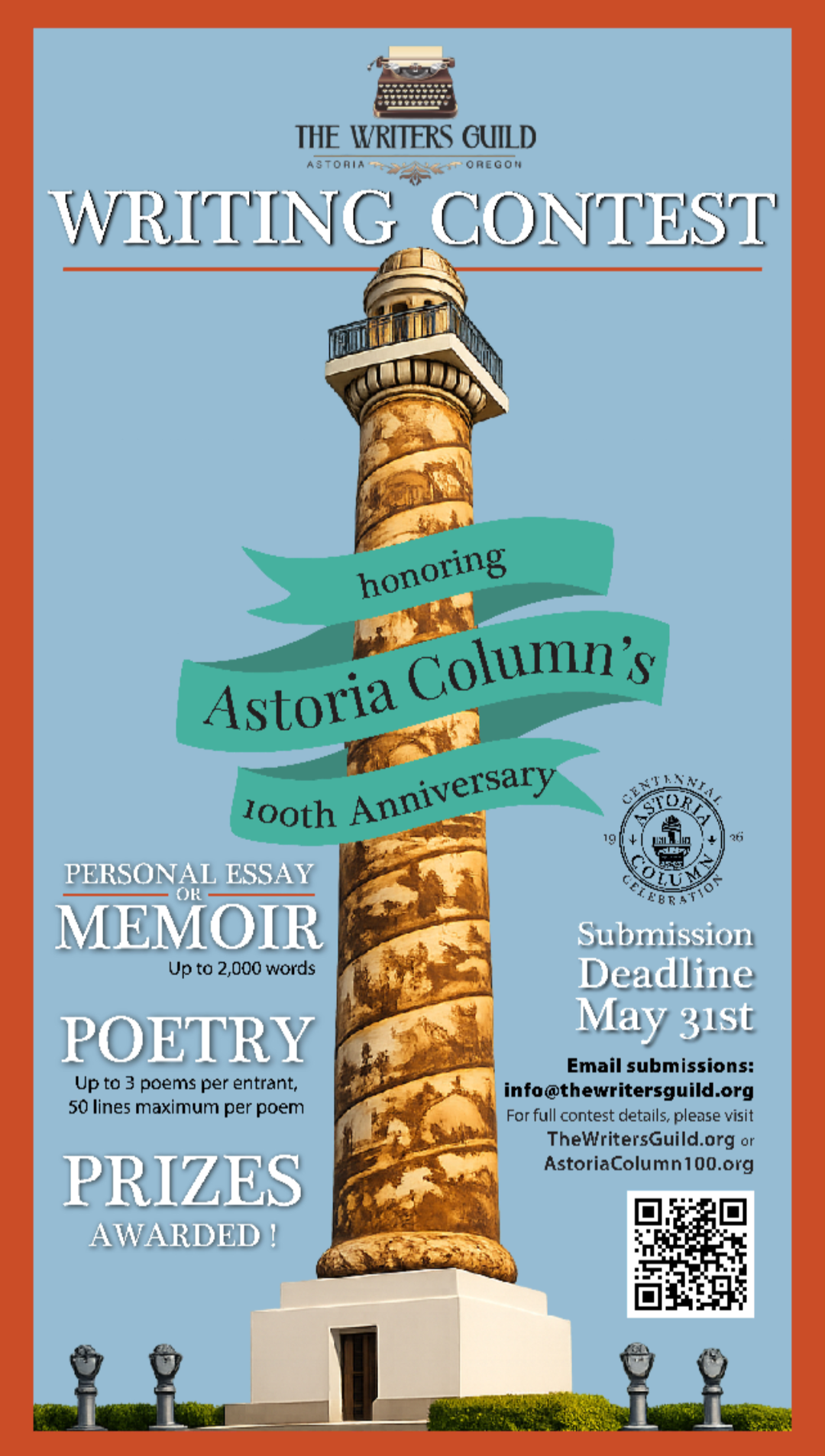
Writing Contest to Honor 100th Anniversary of the Astoria Column
In 1926, high above the meeting of river and sea, the Astoria Column was dedicated as a monument to the layered history of place: Indigenous presence, exploration, migration, industry, and resilience. For one hundred years, it has stood watch over Astoria, rising above forest and fog, a spiral story cast in concrete.
To celebrate the Column’s 100th anniversary in 2026, Friends of Astoria Column, in partnership with The Writers Guild, invites writers to contribute new work that reflects on history, place, memory, and what it means to stand at this turning point.
We seek original, unpublished writing in the following genres:
✦ Poetry
Up to 3 poems per entrant, 50 lines maximum per poem.
✦ Memoir / Personal Essay
Up to 2,000 words.
Theme: Submissions should engage in some way with the Astoria Column: its history, symbolism, physical presence, or the vantage point it offers. Writers might explore themes of arrival, migration, inheritance, legacy, resilience, storytelling, landscape, or the spiral nature of history itself. Work may be contemporary or historical, intimate or expansive.
We welcome work attentive to the many layered stories of the Lower Columbia region.
Judges include:
Ellen Waterston, Oregon Poet Laureate
Joanna Rose*, award-winning novelist
Marianne Monson, Guild Executive Director
*Due to the recent death of Cheryl Strayed’s husband, Brian Lindstrom, she will not be able to judge the entries.
Submission Guidelines
Deadline: May 31, 2026
Open to writers of all ages and backgrounds who live in Oregon and Washington. Categories include: Adults (18+), Children (7-13), and Teenagers (14-17)
One submission per genre per writer.
Include your name, contact information, and a brief third-person bio (50 words or fewer).
Email your submission to: info@thewritersguild.org
Prizes include:
$100 gift card to Lucy’s Bookstore and an Astoria Column Centennial commemorative gift package for each category.
Chosen work will be on display at the Community Celebration on July 18th, as well as on the Astoria Column Centennial website.